
The Expansion Tank: Pressure Relief for Closed Systems
If your home has a closed plumbing system—and most newer homes do—there’s a small tank near your water heater that you might not have noticed. That’s the expansion tank, and it’s doing more important work than its size suggests.
Why You Need One
Water expands when it heats up. A 40-gallon tank of cold water becomes about 41 gallons when heated to typical water heater temperatures. That extra volume has to go somewhere.
In older homes with open plumbing systems, that expanded water simply pushed back into the city water supply. No problem.
But most homes built in the last 20-30 years have check valves or pressure-reducing valves that prevent backflow into the municipal system. That’s good for water quality—but it means your plumbing is now a closed system with nowhere for that extra pressure to go.
Without an expansion tank, that pressure builds up every time your water heater cycles. Over time, this can:
- Stress pipe joints and fittings
- Cause the T&P valve to discharge repeatedly
- Shorten the life of your water heater
- Lead to leaks at the weakest points in your system
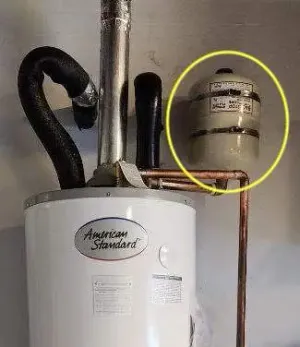
How It Works
The expansion tank is elegantly simple. It’s a small steel tank—usually 2 to 5 gallons— with a rubber bladder inside that divides it into two chambers.
One side connects to your plumbing and fills with water. The other side is pre-charged with air (typically around 40-50 PSI to match your home’s water pressure).
When water heats and expands, it pushes into the tank, compressing the air bladder. When you use hot water and pressure drops, the bladder pushes that water back into the system.
It’s a pressure buffer—absorbing the expansion so your pipes don’t have to.
Where It’s Installed
You’ll typically find the expansion tank:
- On the cold water supply line, near the water heater
- Mounted vertically or horizontally (both work, though vertical is preferred)
- Above the water heater or on an adjacent wall
It should have a shutoff valve nearby for servicing, though not all installations include one.
When to Replace
Most expansion tanks last 5-10 years, depending on water quality and how hard they work. Replacement is straightforward—it’s essentially unscrewing the old one and threading on a new one— but getting the air charge right matters.
If you’re not comfortable checking or replacing it yourself, give us a call. It’s a quick job, and getting it right protects your whole plumbing system.
Signs Your Expansion Tank Needs Attention
Expansion tanks don’t last forever. The bladder inside can fail, or the tank can become waterlogged. Watch for these signs:
- T&P valve dripping frequently — The expansion tank may not be absorbing pressure
- Fluctuating water pressure — Especially noticeable in showers
- The tank feels completely full of water — Tap it; a working tank sounds hollow on top
- Visible corrosion or rust — Time for replacement
- Water dripping from the tank itself — The bladder has failed
A quick test: tap the tank with your knuckle. The bottom (water side) should sound solid. The top (air side) should sound hollow. If the whole tank sounds solid, it’s waterlogged.
Sizing Matters
Expansion tanks come in different sizes, and getting the right one matters. Too small, and it won’t absorb enough pressure. Too large isn’t harmful, but it’s unnecessary expense and bulk.
Common residential sizes:
| Water Heater Size | Expansion Tank Size |
|---|---|
| 40-50 gallons | 2 gallons |
| 50-80 gallons | 4.5 gallons |
| 80+ gallons | 10+ gallons |
But tank size isn’t the only factor. The correct expansion tank also depends on:
- Your home’s water pressure — Higher pressure means more expansion force
- Water heater temperature setting — Hotter water expands more
- System acceptance volume — How much your pipes can flex before pressure builds
Most residential systems with standard 40-50 gallon water heaters do fine with a 2-gallon expansion tank. If you have a larger water heater, multiple water heaters, or unusually high water pressure (above 80 PSI), you may need a larger tank.
Pro tip: The expansion tank’s air pre-charge must match your home’s incoming water pressure. A 2-gallon tank pre-charged to 40 PSI won’t work correctly if your home pressure is 70 PSI— the water will compress the bladder before the tank even starts doing its job.
Checking the Air Pressure
The air side of your expansion tank should be pre-charged to match your home’s water pressure. You can check this with a tire pressure gauge on the Schrader valve (it looks like a tire valve) at the top of the tank.
Before checking:
- Turn off the water supply to the tank
- Relieve pressure by opening a nearby faucet
- Check the pressure with a gauge
If it’s low, you can add air with a bicycle pump or compressor. If it won’t hold pressure, the bladder has likely failed and the tank needs replacement.
Do You Need One?
If your home has:
- A pressure-reducing valve (PRV) on the main water line
- A check valve or backflow preventer
- A recirculating pump system
Then yes, you need an expansion tank. It’s often required by code for new water heater installations.
Not sure if you have a closed system? Look for a bell-shaped device on your main water line near where it enters the house. That’s likely a PRV, which means you have a closed system.
What’s a closed plumbing system?
In a closed system, water can only flow into your home—not back out to the municipal supply. This is typically created by a check valve, backflow preventer, or pressure-reducing valve (PRV) on your main water line. These devices protect the public water supply from contamination, but they also mean your home’s plumbing has no outlet for pressure buildup. Most homes built after the 1990s have closed systems, and many older homes have been retrofitted with them.
Water Heater Services in Your Area
- Water Heater Repair & Replacement
- Water Heater Repair in San Rafael
- Water Heater Repair in Santa Rosa
- Water Heater Repair in Novato
- Water Heater Installation in Petaluma
We proudly serve Sonoma County and Marin County.
Need Professional Plumbing Help?
Our expert plumbers are ready to assist with any plumbing issue.
Schedule Service