
The T&P Valve: Your Water Heater's Safety Release
Most people never notice the T&P valve. That’s fine—it’s supposed to work quietly in the background. But this little brass fitting on the side of your water heater is arguably the most important safety device in the whole system. Worth understanding.
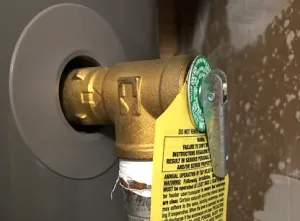
What It Does
T&P stands for Temperature and Pressure. As water heats up, it expands. Pressure builds. If either gets too high, the T&P valve opens and releases some water to bring things back to safe levels.
That’s it. Simple job, critical function.
Without this valve, an over-pressurized tank could fail catastrophically. We’re talking ruptured tanks, flooding, and in extreme cases, explosions. The T&P valve prevents all of that by giving excess pressure somewhere to go.
What Normal Operation Looks Like

The T&P valve connects to a discharge pipe that runs down toward the floor (or outside, depending on your setup). If the valve opens due to excess pressure, water runs from the valve, down the pipe, and outside your home.
Occasional discharge is normal—it means the valve is doing its job. But if you see water dripping constantly or pooling regularly, something’s off. Could be excessive system pressure, a failing valve, or a problem elsewhere. That is the right occasion to call us. This is potentially not just a maintenance issue, but a safety issue.
How to Test It
Manufacturers recommend testing once or twice a year. Here’s how:
- Place a bucket under the discharge pipe
- Lift the test lever on the valve briefly
- Water should flow freely while you hold it
- Release the lever—water should stop completely
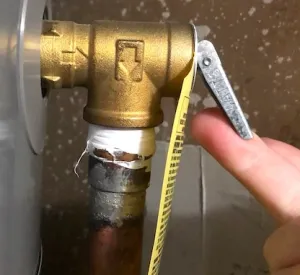
If water doesn’t flow, or it keeps dripping after you release the lever, the valve needs attention. Give us a call.
Fair warning: on older valves, testing can sometimes cause them to leak afterward. If you’re not comfortable doing this yourself, we can test it during a service call.
Never Cap or Block This Valve
This is important: a capped or plugged T&P valve is dangerous. If the valve can’t release pressure, your water heater loses its primary safety mechanism.
If you ever see a T&P valve that’s been capped, plugged, or modified in any way, call us immediately. This needs to be fixed.
Warning Signs
Have the valve checked if you notice:
- Constant dripping from the discharge pipe
- Water pooling near the heater
- Visible corrosion or mineral buildup on the valve
- The test lever won’t move or feels stuck
Most T&P valve issues are straightforward to fix when caught early.
Water Heater Services in Your Area
Need Professional Plumbing Help?
Our expert plumbers are ready to assist with any plumbing issue.
Schedule Service